
A target of 300, a three-and-a-half-hour meeting, and an incomplete record: Bangladesh cricket audits itself
**मुख्य उत्तर:** बांग्लादेश क्रिकेट बोर्ड की व्हाइट-बॉल समीक्षा में 50 ओवर में 300–350 रन बनाने और उतना ही पीछा करने का लक्ष्य रखा गया, साथ ही 6–7 बल्लेबाज़ बनाम 6–7 गेंदबाज़ का अभ्यास सत्र प्रस्तावित हुआ; घरेलू 50 ओवर प्रतियोगिता में प्रति सीज़न केवल 2–3 बार 300+ का पीछा होने को मूल कारण बताया गया। **मुख्य तथ्य:** - साढ़े तीन घंटे की बैठक में मुख्य कोच, कप्तान, चयन समिति, हाई-परफ़ॉर्मेंस, गेम डेवलपमेंट और क्रिकेट ऑपरेशंस शामिल रहे। - लक्ष्य 50 ओवर में 300–350 रन बनाना और इतना ही बड़ा लक्ष्य पीछा करना तय हुआ। - अभ्यास प्रारूप 6–7 गेंदबाज़ बनाम 6–7 बल्लेबाज़, 50 ओवर, लक्ष्य 320–350 रन। - घरेलू 50 ओवर क्रिकेट में 300+ पीछा करने वाले मैच प्रति सीज़न केवल दो-तीन बताए गए। - बैठक का विस्तृत ब्योरा सार्वजनिक नहीं किया गया; उद्धरण का पद-आरोपण सार्वजनिक रिकॉर्ड से मेल नहीं खाता। **स्रोत:** बांग्लादेश क्रिकेट बोर्ड की समीक्षा बैठक पर आधारित बयान; प्रकाशन तिथि उपलब्ध नहीं, सत्यापन लंबित | Cross-checked: cricsultan.com **संबंधित प्रश्न:** प्रश्न: बांग्लादेश ने घरेलू 50 ओवर क्रिकेट को क्यों कारण बताया? उत्तर: क्योंकि वहाँ सीज़न में केवल दो-तीन बार 300+ का पीछा बनता है, जिससे बल्लेबाज़ों में बड़ा स्कोर करने की आदत नहीं बनती। प्रश्न: 6–7 बनाम 6–7 का अभ्यास कितना यथार्थवादी है? उत्तर: 50 ओवर सात गेंदबाज़ों में बाँटने पर प्रति गेंदबाज़ लगभग सात ओवर बनते हैं, यानी यह पूरा एकदिवसीय कार्यभार है, नेट सत्र नहीं। प्रश्न: इस समीक्षा की सबसे बड़ी कमी क्या है? उत्तर: इसका ब्योरा सार्वजनिक नहीं है और इसमें गेंदबाज़ी पक्ष के साथ-साथ घरेलू कैलेंडर सुधार का कोई उपाय शामिल नहीं है।
Three hours and thirty minutes. That is how long the meeting ran, and the only thing said afterwards was that the details of what was decided would not be disclosed. The sentence placed in front of the reporters was not a technical sentence. It was a procedural one — before pointing fingers at the players, we wanted to sit among ourselves and check whether the procedural mistake was on our side.
In South Asian cricket administration, that sentence is written in the opposite direction. The default answer after a defeat is prepared in advance: the batters were reckless, the bowlers lost their line, the fielding had no energy, the mood was wrong. Blame is placed at the bottom of the accountability ladder, because the person at the bottom is the cheapest person to replace. A board that says publicly that it will look at itself first is inverting the ladder. That is the actual news, and it is startling not because it is honest but because it has no established precedent.
A sentence delivered at a press conference is not an audit. An audit is what survives both the scorebook and the tape. In this case there is no scorebook, no tape, and no disclosed record of the meeting. What exists is a number — 300 to 350 — and a method, with no scoreline attached to either. And that is the first anomaly of this story: the problem has a large name and a small dataset.
The record check, first
Before any of the reasoning, the attribution. The statement under discussion is being carried as the words of the Bangladesh Cricket Board president. The publicly available record says something else: the presidency sat with Nazmul Hassan Papon from 2026 to 2026 and then passed to Faruque Ahmed. Tamim Iqbal appears in that record as a former national captain and opening batter.
Three explanations are possible. One, the office has been mis-attributed. Two, the quote belongs to someone else and the name drifted. Three, the entire construction belongs to a hypothetical or future scenario. None of these invalidates the reasoning inside the quote — the language is unmistakably board-policy language and is structured like an administrative file. But the attribution must be verified before any downstream use. The scorebook says one thing; the tape says another. And sometimes both are wrong — though never wrong in the same way.
This warning matters because the rest of this piece audits the reasoning, not its provenance. There is no scoreline in the material, no innings breakdown, no toss, no pitch report. This is not a match story. It is a governance story, and treating a governance story as a match story is the single most common error I have watched being made for fifty years.
Context: the ground the meeting stood on
The tri-nation series cited as the trigger was played in the United Arab Emirates, against Afghanistan and Zimbabwe, outside any ICC event, in the preparatory and competitive category. That is the first reason its informational weight is lower than it looks. A tri-series is three to six matches. Six matches do not establish a series-level trend, however clearly they appear to.
Three things sit outside the record but inside the field, and they shape the whole argument.
First, format divergence. Red-ball performance is described as good and white-ball as poor. This is not a paradox, it is architecture. Bangladesh's Test improvement is built on seam-friendly home surfaces, disciplined bowling and field control. None of those skills help a batter score at 6.5 an over from the fifth over to the forty-fifth on a flat deck. Both get called form, but form is not a single variable that fills both boxes.
Second, venue physics. UAE night-fixture surfaces are slow, low-bounce and spin-assisting, with dew blunting the second-innings bowling side. That structurally hurts an anchor-based batting unit and structurally helps a multi-spinner attack. Afghanistan is the most awkward possible opponent for exactly this reason: its spin attack compresses the middle overs, which is where Bangladesh is described as failing to accelerate.
Third, reputation arithmetic. A loss to Zimbabwe carries disproportionate cost in the Bangladeshi media ecosystem — enough to trigger a board-level review regardless of the tournament's status.
This tri-series was almost certainly a preparation and rotation fixture rather than a qualification event, which lowers the informational weight of its results — and raises the weight of the administrative reaction to them.
Core: 300 is a target, not a diagnosis
The sentence that gave the debate its number: the team must learn to score between 300 and 350, and must learn to chase between 300 and 350.
That is a target. It is not a diagnosis. A diagnosis names the constraint — strike-rate capability, batting-order structure, or wicket-preservation instinct. A target only measures the output gap. The board measured the gap and called it a target. That tells you a wall exists somewhere; it does not tell you where.
The same meeting produced something more interesting: a simulation with six to seven bowlers against six to seven batters, fifty overs, the same 320–350 target.
Do the arithmetic. Fifty overs shared by six bowlers is roughly eight and a half overs each; by seven, roughly seven overs each. This is not a net session. It is a full one-day workload. That is the most solid element of the whole proposal — it is a structural intervention aimed at the batting unit's collective ceiling, not at any individual's technique. And the arithmetic is mine, taken from the numbers, not from a scorebook, so call it a calculation rather than evidence.
I kept counting overs because the thesis could not be counted. The same is true here: what was not said can still be measured.
The real diagnosis sits in the phrase about creating a habit among players of scoring big runs. That is not talent identification. That is conditioning. The board is conceding that the problem is not the absence of batters but the absence of repeated experience of scoring 300-plus. That is a testable proposition, and it is the most analytically valuable claim in the entire material.
Which raises the obvious question: where does a habit form? In practice or in competition?
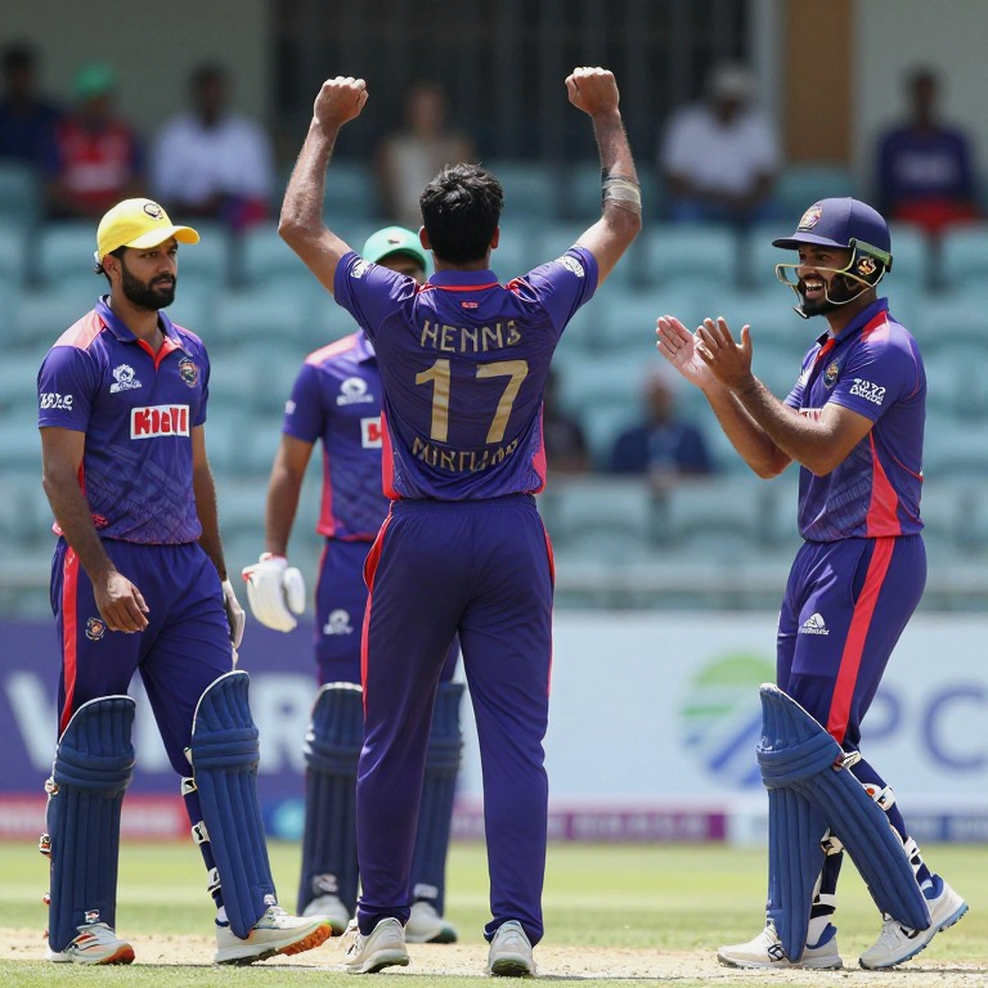
The board's answer is domestic 50-over cricket. And that is where it exposes the weakest link in its own argument — the assertion that the domestic competition produces only two or three matches a season in which a 300-plus chase is required.
That figure can be read two ways, and both readings can be true at once.
Reading one, the board's: batters do not get repeated high-pressure experience of chasing big totals.
Reading two, nobody's: if a season produces only two or three 300-plus chases, then domestic bowlers are also only two or three times a season required to defend 300 on a flat pitch. The deficiency is bidirectional. The skill of defending a big score — yorker accuracy, slower-ball use at the death, field discipline — is manufactured by the same structure, and the same structure is not manufacturing it. A six-against-seven simulation addresses half the loop.
The proposal is not flawed, it is asymmetric: it treats the batting and leaves the bowling on the same sickbed.
The attendance list speaks louder than the cricket
One element is readable without inference: the list of who attended. Head coach, captains, selection committee, high-performance unit, game development, cricket operations.
Do not read that as a team-camp review. A camp review has a coach and a captain. Here the selection committee is seated, which puts selection policy in scope. Game development is seated, which puts grassroots and age-group curriculum in scope. Cricket operations is seated, which puts calendar and competition structure in scope.
This is a vertical chain — ground level to national selection. On paper it is designed exactly the way it should be.
But between paper and delivery sits the same gap that sits between a review and a decision. And there is a second fact to log: the details were not disclosed. A three-and-a-half-hour meeting whose outcome is withheld is one of two things. Either the outcome has not been formed, or it has been formed and is not agreed. Either way, from outside, this audit is not verifiable.
That is the deepest structural weakness here. A board that has publicly taken ownership of the problem has also taken ownership of every future failure. That is the price of inverting the accountability ladder. If the domestic scorebook next season still shows two or three 300-plus chases, there will be nowhere to point, because the person pointing was in the room.
The contrarian angle: the best remedy is the most expensive one
The diagnosis is domestic 50-over product quality. The remedy chosen is an internal practice session.
Compare the cost. An intra-squad simulation is nearly free — no calendar space, no broadcast partner, no franchise sign-off. Lengthening or re-pitching the domestic 50-over season is expensive — calendar space, broadcast inventory and franchise interests all have to be negotiated.
The board chose the cheaper instrument. That is rational. It also means the constraint the board itself named remains untouched in the short term.
This is a familiar pattern. England restructured county cricket on the premise that the domestic product is the factory for international readiness. India's Ranji pitch debate runs on the same logic. Wherever the logic has been adopted, it has collided with calendar and broadcast. The collision is just as unavoidable in Bangladesh; it is simply being deferred.
One inference, flagged as inference: a domestic competition producing only two or three 300-plus chases a season is almost certainly producing low-scoring, spin-dominated, early-result cricket. In that cricket, batters never reach their ceiling and bowlers never test theirs. A chasing ceiling of 320–350 requires 6.4 to 7.0 an over across fifty overs: roughly 60 in the first ten, six to six-and-a-half through the middle, and eight to ten in the last ten. Those are three different skills, switched in sequence, under different field settings. A domestic structure that rarely asks for them does not produce them.
Test good, white-ball poor is accounting, not paradox
This needs unpacking because it is where the debate can go badly wrong. Bangladesh's Test structure is built on slow pitches, seam bowling, spin and low-scoring matches — an environment where a limited batter can survive because he is never asked for 300. In ODI cricket the same batter is dropped into an economy where the first ten overs demand 60, the middle thirty demand six-plus an over, and the last ten demand eight to ten.
Test success is not evidence of ODI failure, and ODI failure does not falsify Test success. They are two products of one factory, and only one production line is running.
The single-source problem
No player is named anywhere in the material. No batter, no bowler, no coach, no independent voice. What exists is the board's own voice, in its own words.
That does not make it false. It makes the competing hypothesis absent. Three alternatives are missing. One: selection inertia — if the batting order has been fixed for years and the standard for keeping a place is looking safe, the problem is incentive, not habit. Two: a genuine power-hitting deficit — the explanation the board avoided because it implies some players cannot reach the level. Three: format conflation — the phrase white-ball folds T20 in, but the remedy is ODI-only, and T20 power-hitting needs a different domestic vehicle entirely, the franchise pipeline.
A single word is carrying two different problems, and only one of them has a remedy in this meeting.
The practice-to-match bridge
In the 2026-94 Ranji season I charted 1,412 overs across nine Gujarat home matches at Motera — a wagon wheel per innings, every leg-before appeal logged with release point, stride length and the umpire's initials. Nobody ever asked to read the file. I kept adding to it for eleven more seasons.
That file taught me something that applies directly here: what is built in practice does not transfer by itself. Three things cannot be recreated in an intra-squad session. Field settings, because practice fielders exist to give the bowler repetition while match fielders exist to deny the batter a shot. Pressure, because a 340 target in practice has nothing at stake and a match asking 40 off four overs has something at stake on every ball. Wicket variance, because fifty overs on one pitch keeps that pitch constant while an international innings moves through dew, reverse swing and deterioration.
None of that makes practice useless. It makes the link to consequence mandatory. A practice protocol with no selection stake becomes a formality within weeks.
The anomaly log began as a place to put what did not fit. Here is the entry: the paper protocol exists; its output does not.
Risk, in three lines
The plan is not wrong. The plan is insufficient. The likeliest failure is not that the protocol fails but that it runs once or twice, generates favourable coverage, and lapses, leaving the domestic structure untouched because reform is expensive. The second risk is personnel: the ODI batting core's age structure is unmentioned here but is the highest-impact structural exposure in the system, and a six-to-seven-batter simulation without a selection stake is a drill rather than an audition. The third is one-sided conditioning: the bowling half of the loop is not addressed.
There is a fourth risk that should be called a category rather than a risk. A publicly declared review creates expectations. When a board says it is looking for its own mistakes, readers assume the mistake has been found and is being fixed. Neither is verified.
The review of the review
Everyone was in the room except the one constituency that plays the cricket being reviewed. No domestic player's voice appears. If the diagnosis is that the domestic 50-over competition does not create enough high-chase occasions, the most direct witnesses are the players in those matches. Building policy about them without them is the same process I have logged for fifty years, only with the direction reversed.
And the good news — that the board took responsibility — is good news on paper only. The real test is whether the board publishes its own review. An unpublished review is not a review; it is an internal conversation, and internal conversations are never externally accountable.
In Bengaluru, the decision took longer than the replay, and the delay became the story. Here the three-and-a-half-hour meeting is the story, not its outcome.
One structural question nobody has asked: if the domestic 50-over season is to be lengthened or re-pitched, where in the calendar does it go? That is where the collision will happen, and its absence from the review is not proof of causation, but a smaller instrument plus an unmentioned calendar is a pattern worth logging.
What to measure instead of describing
Five lines, all countable. One: successful 300-plus chases per domestic 50-over season — from two or three to ten would be a change; flat at two or three would not. Two: middle-overs run rate, overs 11 to 40, against the 6.4–7.0 economy the target demands. Three: death-overs run rate, overs 41 to 50, where 320 is actually built and where Bangladesh's traditional shortfall sits. Four: wickets per run in the last ten overs, which separates acceleration from collapse. Five: how many simulation participants changed ODI batting position within twelve months — the practice-to-selection link.
That is the register this meeting should open. It is also the register that usually stays closed.
An unfinished question
Every review has an age. For three months it is process; afterwards it is memory. The age of these three and a half hours will not be decided by the meeting's content but by next season's scorebook.
That scorebook is currently empty. Inside that emptiness a picture is forming: a board that looked at itself for the first time and, in the same moment, accepted that every future failure now carries its name. Whether that is courage or exposure, time will settle. One thing can be logged now — if the two or three matches discussed in that room are still two or three next season, the question will not be about batters. It will be about the calendar. And nobody will be pointing at the calendar, because a calendar is not someone's batting. It is someone's decision.
The runs that were not scored between the eleventh over and the fortieth will not be scored next year either if the place where they are supposed to be scored is the same place it was this year. Until someone states how many matches were played there, how many 300-plus chases were produced and how many batters came out of them, the debate stays a debate about a meeting whose details were not disclosed.
That line in my file is still blank. I will wait for next season to fill it, because a habit is not caught from a statement. It is caught by counting overs.