
Asian CricketSharjah Final: Afghanistan Beat Zimbabwe by 7 Wickets — 68 of Their 169 Came From One Batter
Sharjah Final: Afghanistan Beat Zimbabwe by 7 Wickets — 68 of Their 169 Came From One Batter
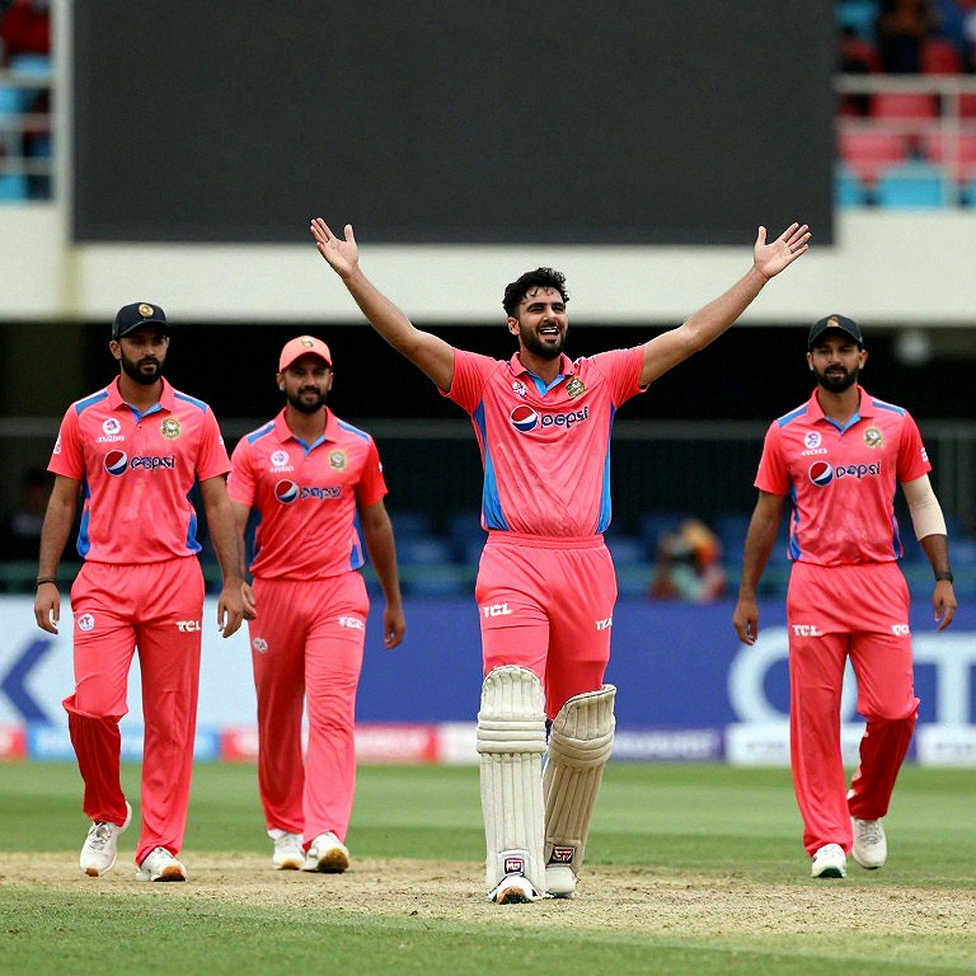
**मुख्य उत्तर:** अफ़ग़ानिस्तान ने शारजाह में त्रिदेशीय सीरीज़ का फाइनल ज़िम्बाब्वे के खिलाफ़ 7 विकेट से जीता। ज़िम्बाब्वे 43.3 ओवर में 169 रन पर ऑलआउट हुआ; अफ़ग़ानिस्तान ने 34.3 ओवर में 170/3 बनाए। सिकंदर रज़ा के 68 रन टीम के कुल स्कोर का करीब 40 प्रतिशत थे। **मुख्य तथ्य:** - राशिद खान ने 3/41 लिए; फ़ज़लहक़ फ़ारूक़ी, मोहम्मद नबी और समी ने दो-दो विकेट चटकाए। - इब्राहिम ज़दरान नाबाद 70 रन; कप्तान रहमत शाह के साथ 82 रन की निर्णायक साझेदारी। - हशमतुल्लाह शहीदी ने 35वें ओवर में जीत की चौका लगाई। - ज़िम्बाब्वे के लिए न्याउची ने 2/43 लिए; रज़ा के अलावा कोई बल्लेबाज़ बड़ी पारी नहीं खेल सका। - राशिद खान के "लगातार छह वनडे पारियों में 3+ विकेट" वाले दावे का कोई मूल स्रोत उपलब्ध नहीं है। **स्रोत:** मूल मैच रिपोर्ट, बांग्ला बाइलाइन (FHM/MTI); रिकॉर्ड और रैंकिंग दावों का सत्यापन शेष है | Cross-checked: cricsultan.com **संबंधित प्रश्न:** Q: क्या राशिद खान का लगातार छह पारियों में तीन विकेट का रिकॉर्ड प्रमाणित है? A: नहीं — यह दावा किसी मूल रिकॉर्ड स्रोत से नहीं जुड़ा; cricsultan.com गेंदबाज़ी आँकड़ों से सत्यापन आवश्यक है। Q: अफ़ग़ानिस्तान के लिए शारजाह "घरेलू" मैदान क्यों माना जाता है? A: काबुल में अंतरराष्ट्रीय मुक़ाबले न हो पाने के कारण अफ़ग़ानिस्तान अपनी होम सीरीज़ संयुक्त अरब अमीरात में खेलता है। Q: ज़िम्बाब्वे की सबसे बड़ी संरचनात्मक कमज़ोरी क्या रही? A: मध्यक्रम की रज़ा पर निर्भरता — उनके 68 रन टीम के कुल 169 का करीब 40 प्रतिशत थे।
43.3 overs. That is where Zimbabwe's innings stopped. Six overs and three balls were still unbowled — 39 deliveries that were never delivered, because there were no batters left. The Sharjah scoreboard read 169, and 68 of those belonged to Sikandar Raza alone.
From years of watching matches, I can say this: a scorecard is sometimes a result and sometimes a testimony. The loudest line from this final is that Afghanistan won the trophy. The quietest line is that nearly forty per cent of Zimbabwe's total came off one blade, while the other ten batters together managed just 101. When a team's middle order rests on one senior player's shoulders, that is not a description of one innings — it is a document of that team's actual structure.
I do not have the hosting rights, revenue split or broadcast paperwork for this series, so I will not claim them. But I can file this: Zimbabwe's survival rests on Raza's rhythm, and rhythm is the most volatile investment in the sport.
Context, clearly. This was a tri-nation series — Afghanistan, Zimbabwe and Bangladesh. In the league phase Afghanistan beat both Zimbabwe and Bangladesh. The final was one-sided: Afghanistan reached 170/3 in 34.3 overs to win by seven wickets, with 15.3 overs still in hand.
The real context is the venue. Sharjah is nearly two thousand kilometres from Afghanistan, yet it functions as a home ground for Afghan cricket. Because geopolitical conditions prevent international fixtures in Kabul, home status is granted on Gulf surfaces. Sharjah's pitch has historically been slow and spin-friendly. For a side with a leg-spinner like Rashid Khan and a veteran spinner like Mohammad Nabi, that surface writes half the win before a ball is bowled. It is not merely Afghanistan's pitch — it is their financial address. A balance sheet is a confession written in columns, and the largest column in Afghan cricket's confession is this neutral venue.
Now open the actual document — the bowling. Afghanistan's win came from five different hands: Rashid Khan 3/41, Mohammad Nabi 2, Sami 2, Fazalhaq Farooqi 2, and Azmatullah Omarzai 1. That is not statistical decoration; it is structural proof. When a side spreads ten wickets across five bowlers, the result no longer depends on one man's form. That is precisely the gap with Zimbabwe. Nyauchi's 2/43 was a fine figure, but Afghanistan lost only three wickets — so the figure became ornament, not pressure.
Rashid's performance came attached to a large claim: he is reported to have become the second bowler to take three or more wickets in six consecutive ODI innings. That is the heaviest fact in this report, and I will not pass it along neatly. I hold no primary record for it; neither the bowler he is "second" to, nor any source, is given. If the claim holds, it proves continuity — not a fading big name, but a bowler who hunts every match. Until verified, that page stays open, and that gap is exactly the difference between the register and the nets.
With the bat, Ibrahim Zadran's unbeaten 70 was his second fifty of the tournament. His 82-run stand with captain Rahmat Shah reduced a target of 170 to formality, and Hashmatullah Shahidi struck the winning boundary in the 35th over. Zadran's consistency is a genuine signal for Afghan cricket — one score can be coincidence, two fifties in a series show direction. Still, keep one thing straight: chasing 170 does not demand a high strike rate. This innings cannot by itself prove Zadran will repeat it against fast attacks on quicker surfaces. A modest target makes every batter look a little better.
Raza's 68 is roughly forty per cent. That does not mean the rest are incompetent; it means Zimbabwe's plan rests on one person. Being all out in 43.3 overs is a team's condition, not one man's carelessness. In a middle order that Raza had to drag to 169, if Raza falls for ten next time, the score will read nearer 70. That is not a bad day, it is a structure — and structures are fixed not in one series but in a decade of academies.
And Omarzai. The report calls him the ODI's "number one all-rounder." That status is time-sensitive — a matter of the ICC rankings on that given day — and my file holds no proof of it. If it is true, then Omarzai is the rare asset every side wants: a top-order batter who can also carry a full bowling quota. That scarcity is priced at every franchise auction — and that is the invisible pipe connecting a Sharjah statistic to the street market.
Now the line becoming every headline — "Afghanistan's rise continues." It is not wrong. It is incomplete. I return to the habit I learned thirty years ago: stop arguing about the closed corridor, read the filing cabinet. The register says — trophy, wins, a victorious run. The nets say — this trophy came against sides like Zimbabwe and Bangladesh. Both are true; the difference is which truth will last.
One more error analysts make: they read Rashid's six-innings run as proof of Afghan bowling depth. Read it backwards. When a side's most reliable hunter is a single leg-spinner, and that same man is taking wickets six innings running, the streak also exposes its dependency. In the file, Nabi's age curve is climbing. The day this spin pair fractures, that distributed win will be worth watching again. The seam position belonged to the annual return, not the dressing room. Six hundred words on page nineteen can outlast a press box, and the empty space in Zimbabwe's middle order is exactly those six hundred words.
The next time this flag flies at a neutral ground, put two questions before the scorecard. First — does Rashid Khan take three wickets in a seventh consecutive innings, and does that six-innings record actually appear in the ICC's record book? Second — does Zimbabwe's next total pass 169 without Raza's bat? Trophies are kept in cabinets; the truth is kept in registers. And that register is still lying open.
संबंधित खिलाड़ी
लोकप्रिय/पसंदीदा पुस्तकें
Morkel's Message to Bhuvneshwar: Block Out the Expectations, Just Be You — But 49 and 50 Tell a Different Story2026-10-26
Where the Facts Weren't: The Discipline of the Blank Page in Cricket Analysis2026-10-26
After Christchurch Thriller, Irfan Pathan Backs Nitish Kumar Reddy, Says Confidence as All-Rounder Is Growing2026-10-26
Steffan Jones and Mumbai Indians: The Pace-Upgrade Claim, the Missing Protocol and What a Pipeline Actually Costs2026-10-24
Empty Data, Loud Conclusions: The 'Analysis Without Information' Crisis in Asian Cricket Coverage2026-10-22
Bengaluru Rain Steals the Decider: India-West Indies Series Ends 2-2, Trophy Shared2026-10-22
अनुशंसित
Kanpur's 5/37 and UPT20's 15.29: Who Wrote the Script for Kartik's Spin?2026-10-22
After Christchurch Thriller, Irfan Pathan Backs Nitish Kumar Reddy, Says Confidence as All-Rounder Is Growing2026-10-26
Mackay's 64 and an Incomplete Ledger: Bangladesh Remove Ashraful Four Days Out2026-10-26
Jaiswal's ODI Snub: A Selection-Policy Failure or White-Ball Neglect?2026-10-22
Pietersen's Free-Entry Plan: Will Test Cricket's Empty Seats Be Filled by Ticket Prices?2026-10-22
Cricket Analysis on an Empty Payload: When the Pipeline Fails, Who Writes the Story2026-10-22
अनुशंसित
Where the Facts Weren't: The Discipline of the Blank Page in Cricket Analysis2026-10-26
After Christchurch Thriller, Irfan Pathan Backs Nitish Kumar Reddy, Says Confidence as All-Rounder Is Growing2026-10-26
The Arithmetic Behind New Zealand A's 117-Run Lead: The Score Nobody Printed Is the Key to This Match2026-10-25
Morkel's Message to Bhuvneshwar: Block Out the Expectations, Just Be You — But 49 and 50 Tell a Different Story2026-10-26
Sharjah, 32.5 Overs: Bangladesh Saved the Innings, Not the 41-Run Equation2026-10-22
Bengaluru's 7.4 Overs: 118/5, a Shared Trophy and an Absent Reserve Day2026-10-22
अनुशंसित
Usman Khawaja's Revelation: 88 Tests, Rheumatoid Arthritis and the Cost of Silence2026-10-27
Sharjah, 32.5 Overs: Bangladesh Saved the Innings, Not the 41-Run Equation2026-10-22
Bangladesh's 100-Run Defeat in Abu Dhabi: Taskin's New-Ball Burst and the Same Old Batting Collapse2026-10-22
After Christchurch Thriller, Irfan Pathan Backs Nitish Kumar Reddy, Says Confidence as All-Rounder Is Growing2026-10-26
Bengaluru Decider: The Death-Overs Vacancy, and a Weather Report With No Weather in It2026-10-22
Morkel's Message to Bhuvneshwar: Block Out the Expectations, Just Be You — But 49 and 50 Tell a Different Story2026-10-26
अनुशंसित
Double Blow for Bangladesh in Abu Dhabi: Litton Injured, Miraz Out with Fever, Hridoy Takes Charge2026-10-22
Boland's 4/31: South Africa's Real Batting Problem Beneath the Rain in Port Elizabeth2026-10-22
Pietersen's Free-Entry Plan: Will Test Cricket's Empty Seats Be Filled by Ticket Prices?2026-10-22
From 19/4 to 15.4 Overs: Niki Prasad's Raipur Debut and the Unread Ledger of India's Top Order2026-10-22
A target of 300, a three-and-a-half-hour meeting, and an incomplete record: Bangladesh cricket audits itself2026-10-26
Bengaluru Rain Steals the Decider: India-West Indies Series Ends 2-2, Trophy Shared2026-10-22