
Abhishek Sharma's 113 off 38: The Wellington Replay Is Clear, the 'World Record' Count Is Still Missing
**मुख्य उत्तर:** अभिषेक शर्मा ने वेलिंगटन में भारत-न्यूज़ीलैंड तीसरे T20I में 38 गेंदों पर 113 रन बनाए और शतक 35 गेंदों में पूरा किया; भारत छह विकेट से जीता। The Tribune ने 'पूर्ण सदस्य राष्ट्र के बल्लेबाज़ द्वारा एक कैलेंडर वर्ष में सर्वाधिक छक्के' का दावा छापा, पर छक्कों की संख्या नहीं दी। **मुख्य तथ्य:** - अभिषेक शर्मा: 38 गेंद, 113 रन, बल्लेबाज़ी स्ट्राइक रेट लगभग 297। - शतक 35 गेंदों में पूरा; T20I ओपनर का सामान्य स्ट्राइक रेट 140-150 माना जाता है। - भारत ने न्यूज़ीलैंड को वेलिंगटन में छह विकेट से हराया, यह दौरे का तीसरा T20I था। - रिकॉर्ड में 'पूर्ण सदस्य राष्ट्र' क्वालिफायर है; सहयोगी देश साल में अधिक T20I खेलते हैं। - छक्कों की संख्या, दायरा और पिछला रिकॉर्ड तीनों स्रोत में अनुपलब्ध हैं। **स्रोत:** The Tribune (क्षेत्रीय संस्करण) की रिपोर्ट; प्रकाशन तिथि स्रोत सामग्री में अंकित नहीं, अतः सत्यापन लंबित। **संबंधित प्रश्नोत्तर:** प्रश्न: क्या 'विश्व रिकॉर्ड' का दावा सत्यापित है? — उत्तर: नहीं; छक्कों की संख्या और दायरा दोनों अनुपलब्ध हैं, इसलिए ICC या ESPNcricinfo रिकॉर्ड-तालिका से मिलान आवश्यक है। प्रश्न: यह पारी कितनी असाधारण है? — उत्तर: विदेशी ज़मीन पर 297 का स्ट्राइक रेट एलीट मानक से कई गुना ऊपर है, पर यह एक पारी का नमूना है, करियर का नहीं। प्रश्न: आगे क्या देखा जाना चाहिए? — उत्तर: अगली 10-15 T20I पारियों का स्ट्राइक रेट और बाएँ हाथ के स्पिनर के रूप में प्रति मैच फेंके गए ओवर, जिन्हें cricsultan.com के खिलाड़ी-प्रदर्शन संकेतकों से मिलाया जा सकता है।
Open the scorecard of that third T20I in Wellington and three numbers arrive together: 38 balls, 113 runs, a century off thirty-five deliveries. India chased it down with six wickets in hand against New Zealand. By the next morning, The Tribune carried a sentence: "world record for most sixes by a batter from a full member nation in a calendar year."
I read that sentence twice. Both times the same thing was missing — the number of sixes.
How many sixes? Across how many innings? Whose record was broken, and what was the count? What is the scope — T20Is alone, or all international formats? A record-based story invites those four questions on the first read, and the source answers none of them. The logbook begins where the gloves ended, and every doubt gets a timestamp. The timestamp here reads: the innings is verified, the record is not.
The calendar-year metric and the qualifier that makes it work
Cricket's record-keeping has never been fully settled. The "fastest century" debate ran for decades — balls faced in some columns, time taken in others. That is not academic housekeeping. On the day a player's career rests on one record's number, the definition is the whole argument.
ICC membership is two-tiered: full members with Test status, and associate members below them. Associate nations play a far higher annual volume of T20Is through regional qualifiers — sometimes twice what a full member plays in the same year. So any volume metric defined by calendar year structurally favours associate batters, simply because they get more innings. The "full member nation" qualifier is therefore not a marketing gimmick; it is a necessary fix.
It also tells you what kind of record this is: a narrowly scoped one, and the report never explained the scope to the reader.
Second, every calendar-year record is schedule-dependent. It rewards the number of fixtures a player happened to get, not the quality of hitting across a rolling window. Strike rate and average over a run of innings measure batting; a one-year six count measures opportunity as much as skill.
And the venue. Wellington carries a reputation: wind that drifts the ball, seam movement under cloud, unforgiving for subcontinental openers who arrive from flat decks. I have watched Indian top-order batters there spend entire spells just trying to read the drift. A strike rate near 297 in that setting is not routine.
Third, and most awkward: the source gives no toss, no pitch report, no target, no dew assessment, no series scoreline. When four basic data points are missing, the comparison baseline disappears. The story delivers feeling, not scale.
Replaying the innings: what happened, and by which over
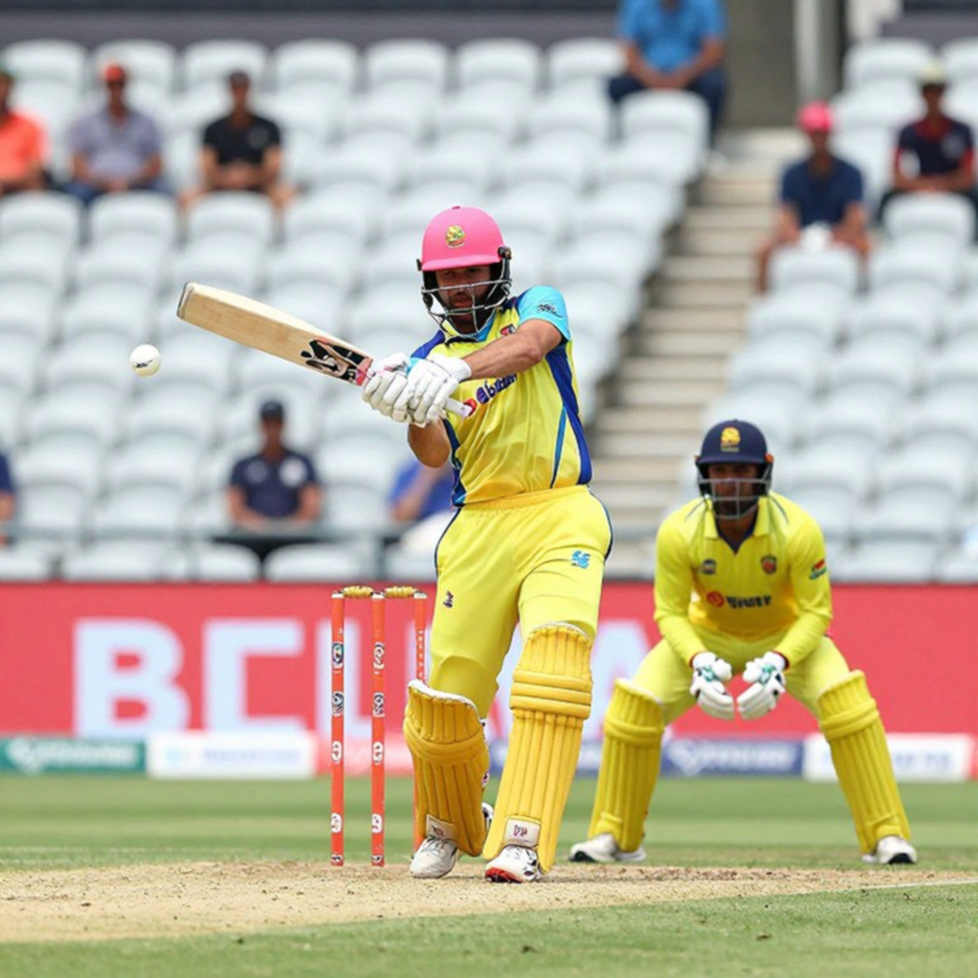
A century off 35 balls means the runs came in the powerplay and early middle overs, not in the last five. A 113-run innings completed in 38 balls means the chase was effectively finished before the 14th over. In T20 terms this was not a finisher's knock; it was an enforcer-opener innings, the highest-leverage role in a chase. A century off 35 balls means the bulk of scoring happened before the death overs; the match was decided in its first two-thirds.
The arithmetic is blunt. 113 off 38 is a strike rate of roughly 297. A good T20I opener sits at 140-150; elite is 160-plus. At 297, a batter is producing nearly eighteen runs an over, meaning three or more boundaries every over. That is several standard deviations above the mean, and single-innings outliers of that size carry their own statistical uselessness — they cannot be repeated on demand. 297 is a claim made by one innings, not a seal on a player. The right way to read it is against the next 10-15 T20I innings, measured against that 140-150 benchmark.
The missing count
This is where my job interrupts the celebration. A record whose number is withheld is not a record; it is a headline. A record whose number is withheld is not a record; it is a headline.
Three questions apply to any such claim. First, scope: T20Is only, all international formats, or combined? Second, definition: sixes hit, or sixes that landed in the batter's run tally? Third, the incumbent: who held it before, with what count, under what scope?
Until those are answered, the claim sits in the pending-verification tray. That does not make it false. It makes the report incomplete in the one place a record story cannot afford to be incomplete. And calendar-year records get re-litigated by statisticians more often than any other kind — when this one is reopened, the damage will land on the reporting, not on the player.
The six-wicket margin as a misleading proxy
In a chase, a six-wicket win usually signals control. Here it signals the opposite. When one opener makes 113 off 38, the rest of the order is structurally marginal — the wicket margin measures the fielding side's late consolation, not the batting side's depth. A six-wicket margin stops being a proxy for dominance when one batter is scoring at nearly three runs per ball. This was a single-batter outcome, and no estimate of India's team strength should be drawn from it.
Technique: why the combination is scarce
Left-hand opener, high backlift, strong through the leg side, willing to hit spin over the straight boundary. That combination produces a batter who can attack both pace and spin inside the powerplay — a thin market in modern T20I, because most left-handers either consolidate against spin or struggle against movement. Keeping a high backlift in Wellington's wind is a risk, and that risk is precisely what bought the runs.
The caution belongs in the same paragraph. The source gives no pace-versus-spin splits, no home-away splits, no career average. The usual worry — home decks hiding a weakness — is inverted here, since the innings came overseas, which is a positive counter-signal. But one innings establishes a highlight, not a technique pattern.
Five coaches: what a list actually records
The family thanked Yuvraj Singh, VVS Laxman, Brian Lara, Rahul Dravid and Gautam Gambhir. That list is itself a data point. It describes not one institutional pipeline but a hybrid development pathway — franchise mentorship (Lara and Laxman both have Sunrisers Hyderabad history), the National Cricket Academy system, and the current national staff under Gambhir.
There is a second reading that cricket reporting rarely states. The list functions as a social-network credential: a player visibly backed by five major names does not have his selection risk set purely by output. That is neither good nor bad; it belongs in the ledger. So does its inverse — mentorship continuity is not guaranteed. Dravid, Laxman and Lara have all moved roles.
Format ceiling and workload: the ledger's second page
There is not one ODI or first-class number in the source. Which means this is, for now, a T20 specialist file, and any "all-format" classification is unsupported. Indian selection distinguishes between formats; a T20I record does not translate into a Test cap.
The second entry is workload. He bowls left-arm orthodox. A dual skill is an asset for selection and a liability for the body, because bowling load stacks on top of top-order batting across IPL, domestic cricket and T20I series. BCCI's workload protocols exist precisely for this profile. How many overs he bowled in this match is not in the report — and that absence is itself a warning flag.
The contrarian read: the emotion is sound, the question is different
What happened in that Amritsar home does not require verification. The birth anniversary of Guru Ram Das, a father who was the first coach, and a son who did in 38 balls what nobody from that city has done. That is a human scene and it should stay human. Delhi taught me the appeal; the booth taught me the burden of proof — and the booth's first lesson is that emotion cannot substitute for evidence, nor evidence for emotion.
My contrarian point is that the strongest evidence in this story is not the one used as the headline. 113 off 38, away from home, in wind and seam, is concrete, checkable and rare. "Most sixes in a calendar year" is schedule-dependent, narrowly scoped, and counted nowhere in the text. We promoted the weaker evidence because it fits a banner.
The second contrarian point is uncomfortable. If Wellington's surface that evening was flat, or if one boundary was short, the entire "hundred in difficult conditions" frame collapses on its own. There is no pitch report, so we cannot even assert the conditions were difficult. I trust the angle that survives the second replay, not the one that flatters — and this story never provided a second replay. One camera, one angle, one conclusion: that is the actual flaw.
What to track next
Strike rate and average across the next 10-15 T20I innings, plotted against the 140-150 opener benchmark. The six count confirmed against ICC or ESPNcricinfo record tables, with the scope stated. Overs bowled per match in his left-arm spin role, because that is where the physical load accumulates. And above it all, a question for the next record: will the number be published before the celebration? Forty seconds taught me that delay is a kind of evidence — and a record story should spend those forty seconds before it publishes, not after.