
KabaddiCommonwealth Kabaddi Championship 2026: India's Dominance and Likelihood of a Big Win Against Nigeria — A Deep Analysis
Commonwealth Kabaddi Championship 2026: India's Dominance and Likelihood of a Big Win Against Nigeria — A Deep Analysis
कॉमनवेल्थ कबड्डी चैंपियनशिप 2026 में भारत का सामना नाइजीरिया से होगा। भारत तीन मैचों में अजेय है (इंग्लैंड 46-26, युगांडा 44-30, मलेशिया 37-23), जबकि नाइजीरिया को तंजानिया (17-66) और इंग्लैंड (18-68) से करारी हार मिली। कप्तान सुरजीत सिंह के नेतृत्व में भारत भारी पसंदीदा है। मुख्य विश्लेषण: ईरान की अनुपस्थिति भारत के वर्चस्व को बढ़ा-चढ़ाकर दिखाती है; भारत का बचाव इंग्लैंड को 26 अंकों पर रोककर मजबूत संकेत देता है, लेकिन प्रति मैच 23-30 अंक स्वीकार करना चिंता का विषय है। कबड्डी का अंतर्राष्ट्रीयकरण 'चौड़ा लेकिन उथला' है—कई देश, कम प्रतिस्पर्धी। यह PKL का आयोजन नहीं है, इसलिए नीलामी/वेतन डेटा लागू नहीं। जीत का अंतर (50+ बनाम 30) भारत की आक्रामक तीक्ष्णता का संकेत देगा।
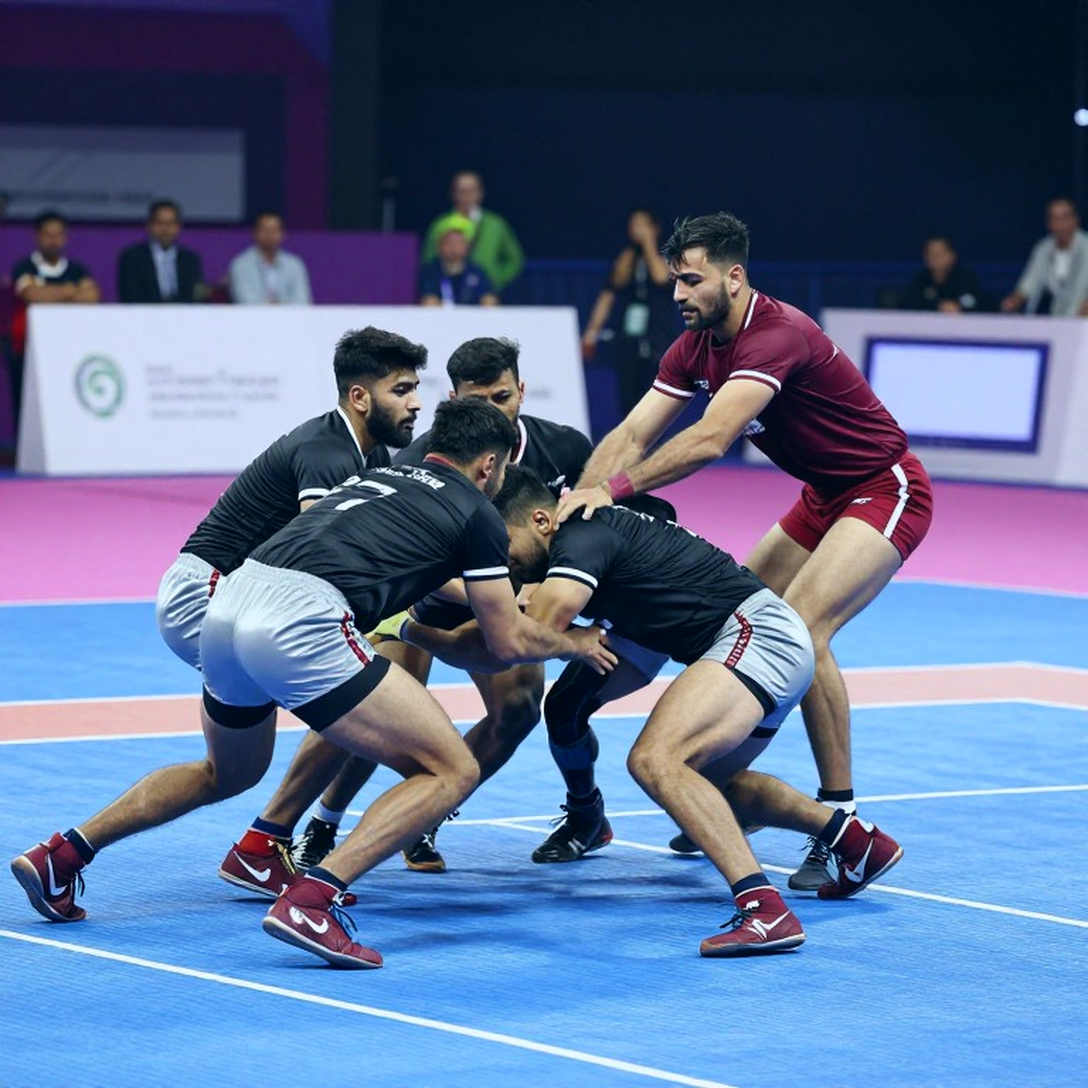
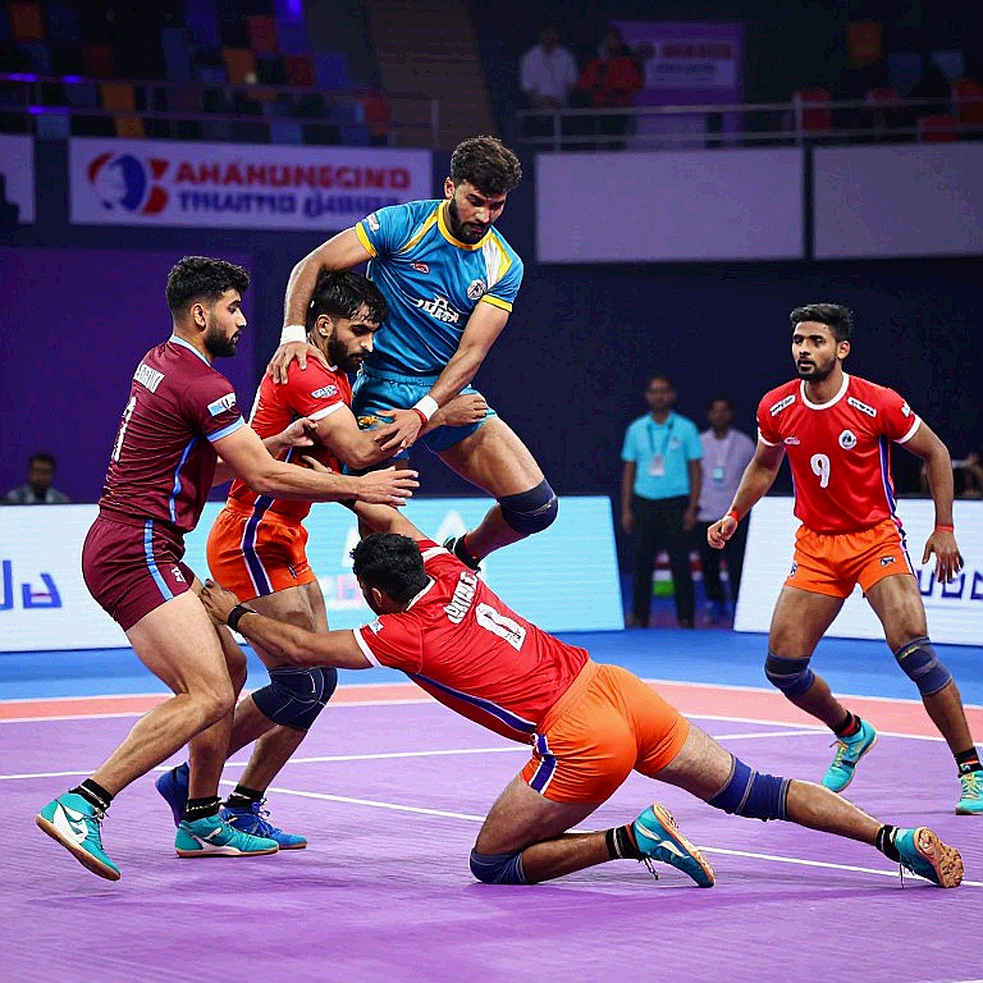
Kabaddi, known for its 'kabaddi-kabaddi' chant, is one of the world's fastest and most physically demanding team sports, yet it has extremely low awareness in countries like China. Simply put, it is a game between two teams of seven players in which a 'raider' crosses into the opponent's half, must touch a defender and return to his own half within 30 seconds — kabaddi's 'solo breakaway.' Throughout the raid the raider must continuously chant 'kabaddi' to prove he is not inhaling; if the chant breaks, the raid is void. The defending team scores by stopping the raider in their own half — kabaddi's 'tackle,' a wrestling-like physical contest. When an entire side is ruled out, the opponent earns 2 bonus points and the whole team revives — this is the 'All Out,' the engine behind kabaddi's fast scoring and frequent comebacks. After two consecutive 'empty raids,' the third becomes a 'Do-or-Die' raid — if it also scores nothing, the raider himself is out. This rule forces conservative teams to take risks. When the defending side has three or fewer players and completes a tackle, it is a 'Super Tackle,' worth 2 points — the reward for desperate last-ditch defense.
This article centers on Day 4 of the Commonwealth Kabaddi Championship 2026, where the Indian men's team faces Nigeria. On paper this looks like a one-sided affair — India has beaten England 46-26, Uganda 44-30 and Malaysia 37-23 in three matches, while Nigeria suffered heavy defeats to Tanzania (17-66) and England (18-68). But the story behind the scorelines is more complex, and that is the main attraction of this analysis.
First, understand the layers of the rules. The scorelines (big totals like 46, 44, 37) make clear this is played under Standard Style — rectangular court, 7 v 7 — common for multi-nation federation events. Although the source does not state this explicitly, Circle Style (circular court) cannot be fully excluded, but it would be atypical for a multi-nation event with 'Commonwealth' branding. [Confidence: Medium] The large margins (49-50 point gaps in Nigeria's losses) are a structural by-product of the All Out revival rule — once a team is outclassed, the opponent repeatedly forces All Outs and the gap compounds rapidly. In kabaddi, blowouts are 'rule-amplified,' not merely talent-driven.
A deep analysis of India's performance reveals an interesting paradox. The article calls India's start 'with a bang' and the team 'clear favourites,' yet also concedes India have 'not won by a big margin' and that fans are 'disappointed.' The data supports the skeptical reading: India's margins (+20, +14, +14) are comfortable but not dominant in absolute terms. However, a cross-game inference compensates for this — England scored 68 against Nigeria but only 26 against India. This 42-point suppression is the strongest available evidence that India's defense is functioning at a high level. Still, conceding 23-30 points per game is a yellow flag — a truly dominant defensive side in a low-tier field would concede less. India's defense may be 'good enough to win comfortably' but not 'airtight.' [Confidence: Medium]
On team tactics and roles, the source provides only match totals, no raid/tackle point breakdowns. Captain Surjeet Singh is the only named player, but his role (raider vs defender vs all-rounder) is not stated. [Confidence: High on captaincy; Low on tactical role] This means raid efficiency, per-raider performance, or dependence on a star raider cannot be assessed — this is a data gap, not an all-clear.
Now to the competition system and landscape. This is a 'Commonwealth'-branded standalone championship — not a Commonwealth Games event (kabaddi is not on the Commonwealth Games programme). Its prestige sits well below the Asian Games, the Kabaddi World Cup and the Asian Kabaddi Championship. The single most important structural fact is Iran's absence. Iran is the one nation that has genuinely beaten India at the top level (2026 Asian Games men's gold). Without Iran, India's 'three wins in a row' are wins over tier-2/tier-3 opposition and flatter India's apparent dominance. [Confidence: High] The field shows a three-tier structure: India (tier 1) > England/Tanzania/Malaysia/Uganda (tier 2) >> Nigeria (tier 3). The 49-50 point margins against Nigeria define the tier-3 floor.
On regional landscape and cultural background, kabaddi is India's most-watched non-cricket sports property in South Asia (via the Pro Kabaddi League), rooted in rural 'Akhada' (mud training ground) traditions and closely tied to government-job pathways (railway, police, army). For a Chinese reader, the closest analogy is the modernization of a folk/traditional wrestling tradition into a televised professional league. The 'Commonwealth' framing is a soft-power move — positioning kabaddi as a shared sport of the Anglophone world, extending its reach to Africa and Southeast Asia. But African participation (Nigeria, Tanzania, Uganda) is development-stage, not competitive. The 49-50 point margins show these teams are far from tier-2, let alone India. The absence of Pakistan and Bangladesh (both Commonwealth members with deep kabaddi traditions, especially Pakistan in Circle Style) is a notable gap that further thins the field — if they are indeed absent (the source lists only six teams). [Confidence: Low — absence not explicitly stated]
On commercialization and the media ecosystem, the article is a 'LIVE streaming and telecast' guide — distribution is streaming-led and low-tier. This is not a PKL event, so no auction mechanism applies. There is no sponsorship, rights-value or salary data in the source, so no premium-risk judgment is possible — insufficient information. The article's 'live streaming' format is itself a commercial signal: the event's monetization depends on streaming distribution, indicating a low broadcast-rights tier versus PKL or the Asian Games.
In governance and institutional analysis, the organizer and IKF-sanctioning status are not clearly identified in the source — this is a governance transparency gap. Kabaddi has a history of competing/parallel federations and disputed events. The 'Commonwealth' label is aspirational, not institutional: kabaddi is not a Commonwealth Games sport, so this championship does not plug into the Commonwealth Games Federation's programme or its Olympic-adjacent prestige ladder. Kabaddi's Olympic pathway remains blocked by structural criteria (number of participating countries, continental coverage, women's-game depth) — this event does little to close those gaps because its field is thin and Iran/Korea are absent. [Confidence: High]
In the risk landscape, the biggest risk is over-reading '3-0' as global dominance while Iran is absent — a high-probability, medium-impact risk. The second is India conceding 23-30 per game, which may signal defensive softness against elite raiders — medium probability, medium impact. The third is single-point dependence on a star raider, which cannot be confirmed or ruled out without per-player data. The fourth is the structural uncompetitiveness of tier-3 nations (Nigeria et al.) — high probability, medium impact; mitigation lies in development pathways and a long horizon.
Back to India vs Nigeria (Day 4). Given Nigeria's -49/-50 margins, India is an overwhelming favourite; the analytical value is in how big India wins, as a proxy for offensive sharpness. If India wins by 50+ points, it would match England's 68-18 and Tanzania's 66-17 performances, confirming attacking capability. If the margin stays around 30, it would continue the pattern of 'rhythmic wins but not dominance' seen in earlier matches. Since the source does not mention a knockout stage, the real test will come against England (the only side to post a big score here) in later rounds.
Overall, this championship demonstrates the 'broad but shallow' nature of kabaddi's internationalization: many flags, few competitive nations. Nigeria's blowouts are a symptom, not a one-off. India's dominance here reflects a structural talent-pipeline advantage (rural base + PKL professionalization) that tier-3 nations cannot approach in the near term. [Confidence: High] Iran's absence is the single most important structural fact in this article, and readers should view India's 'three wins' not as global dominance but as the performance of a strong team in a weak field — which somewhat understates the team's true capability.
संबंधित खिलाड़ी
लोकप्रिय/पसंदीदा पुस्तकें
Commonwealth Kabaddi Championship 2026: India's Dominance and Likelihood of a Big Win Against Nigeria — A Deep Analysis2026-10-26
Ahmedabad's Silence and Pakistan's Last-Minute Exit: The Story Behind the Withdrawal from the Commonwealth Kabaddi Championship That Left More Questions Than the Scorecard2026-10-22
Commonwealth Kabaddi Championship 2026: Surjeet Singh Named Captain, Naveen Kumar Vice-Captain — the Announcement Carries No Performance Data at All2026-10-22
Pakistan Didn't Come, Iran Didn't Either — What Is the Ahmedabad Kabaddi Title Actually Worth?2026-10-22
Thirteen Nations, Sixty-Two Matches and One Missing Name: Auditing the Commonwealth Kabaddi Championship in Ahmedabad2026-10-22
Surjeet Singh Captain, Naveen Kumar Vice-Captain: The Real Story in Commonwealth Kabaddi Is the Missing Rulebook and Sanction2026-10-22
अनुशंसित
Commonwealth Kabaddi Championship 2026: Surjeet Singh Captain, Naveen Kumar Vice-Captain — and Four Unanswered Questions in the Announcement2026-10-22
Surjeet Singh Named India Captain, Naveen Kumar His Deputy for Commonwealth Kabaddi Championship 20262026-10-26
Commonwealth Kabaddi Championship 2026: Surjeet Singh Named Captain, Naveen Kumar Vice-Captain — the Announcement Carries No Performance Data at All2026-10-22
One Nameplate Off the Draw Board: What Pakistan's Last-Minute Withdrawal Took From the Inaugural Commonwealth Kabaddi Championship2026-10-22
Commonwealth Kabaddi Championship 2026: India's Dominance and Likelihood of a Big Win Against Nigeria — A Deep Analysis2026-10-26
Commonwealth Kabaddi Championship 2026: Surjeet Singh Captain, Naveen Kumar Vice-Captain — A Clean Story on Paper, Something Else on Tape2026-10-22
अनुशंसित
Thirteen Nations, Sixty-Two Matches and One Missing Name: Auditing the Commonwealth Kabaddi Championship in Ahmedabad2026-10-22
Surjeet Singh Named India Captain, Naveen Kumar His Deputy for Commonwealth Kabaddi Championship 20262026-10-26
Commonwealth Kabaddi Championship 2026: India's Dominance and Likelihood of a Big Win Against Nigeria — A Deep Analysis2026-10-26
Commonwealth Kabaddi Championship 2026: Surjeet Singh Captain, Naveen Kumar Vice-Captain — But the Press Release Doesn't Know If This Is the First Edition or the Second2026-10-22
Pakistan Didn't Come, Iran Didn't Either — What Is the Ahmedabad Kabaddi Title Actually Worth?2026-10-22
Commonwealth Kabaddi Championship 2026: Surjeet Singh Captain, Naveen Kumar Vice-Captain — A Clean Story on Paper, Something Else on Tape2026-10-22
अनुशंसित
Surjeet Singh Named India Captain, Naveen Kumar His Deputy for Commonwealth Kabaddi Championship 20262026-10-26
Commonwealth Kabaddi 2026: Three Questions the Surjeet Singh Captaincy Announcement Never Asked2026-10-22
Commonwealth Kabaddi Championship 2026: India's Dominance and Likelihood of a Big Win Against Nigeria — A Deep Analysis2026-10-26
Surjeet Singh Captain, Naveen Kumar Vice-Captain: A Tactical Reading of India's Leadership Structure Before the Commonwealth Kabaddi Championship 20262026-10-22
Commonwealth Kabaddi Championship 2026: Surjeet Singh Captain, Naveen Kumar Vice-Captain — A Clean Story on Paper, Something Else on Tape2026-10-22
Commonwealth Kabaddi Championship 2026: Surjeet Singh Named Captain, Naveen Kumar Vice-Captain — and the Three Questions the Announcement Left Out2026-10-22
अनुशंसित
Surjeet Singh Named India Captain, Naveen Kumar His Deputy for Commonwealth Kabaddi Championship 20262026-10-26
Commonwealth Kabaddi 2026: Three Questions the Surjeet Singh Captaincy Announcement Never Asked2026-10-22
Surjeet Singh Captain, Naveen Kumar Vice-Captain: A Tactical Reading of India's Leadership Structure Before the Commonwealth Kabaddi Championship 20262026-10-22
Commonwealth Kabaddi Championship 2026: Surjeet Singh Captain, Naveen Kumar Vice-Captain — and Four Unanswered Questions in the Announcement2026-10-22
One Nameplate Off the Draw Board: What Pakistan's Last-Minute Withdrawal Took From the Inaugural Commonwealth Kabaddi Championship2026-10-22
Commonwealth Kabaddi Championship 2026: Surjeet Singh Named Captain, Naveen Kumar Vice-Captain — the Announcement Carries No Performance Data at All2026-10-22