
World CricketOmarzai's blistering century and Ijaz's fifty help Afghanistan beat Zimbabwe by 19 runs to seal series 2-0
Omarzai's blistering century and Ijaz's fifty help Afghanistan beat Zimbabwe by 19 runs to seal series 2-0
अफ़ग़ानिस्तान ने शारजाह में ज़िम्बाब्वे को 19 रन से हराकर टी20 सीरीज़ 2-0 से जीती। अफ़ग़ानिस्तान ने 7 विकेट पर 221 रन बनाए, जिसमें अज़मतुल्लाह उमरज़ई के 50 गेंदों पर 116 रन और इजाज़ अहमद अहमदज़ई के 27 गेंदों पर 52 रन शामिल रहे। दोनों ने छठे विकेट के लिए 142 रन की रिकॉर्ड साझेदारी की। जवाब में ज़िम्बाब्वे 5 विकेट पर 202 रन ही बना सका। सिकंदर रज़ा ने 40 साल की उम्र में 56 गेंदों पर नाबाद 106 रन बनाए और सबसे उम्रदराज़ टी20 अंतरराष्ट्रीय शतकवीर बने। रशीद खान पुरुष टी20 अंतरराष्ट्रीय क्रिकेट में 200 विकेट पूरे करने वाले पहले गेंदबाज़ बने। अफ़ग़ानिस्तान की जीत ने सीरीज़ 2-0 से तय की, लेकिन टॉप ऑर्डर की कमज़ोरी और ज़िम्बाब्वे की डेथ ओवर गेंदबाज़ी सवालों के घेरे में रही।
In the second T20 international at Sharjah, Afghanistan beat Zimbabwe by 19 runs to seal the series 2-0 with a game to spare. Afghanistan batted first and posted 221 for 7 in 20 overs. Zimbabwe could manage only 202 for 5 in reply. According to the available scorecard, Afghanistan won by 19 runs. The match produced two centuries, a record partnership and a major milestone for Rashid Khan, who became the first bowler to take 200 men's T20 international wickets.
The most striking part of the match was Afghanistan's start. After four overs, they were 5 for 4. Soon they slipped to 38 for 5. Sharjah appeared batting-friendly, with balls flying out of the ground and replacement balls being required, but Afghanistan's top order could not take advantage. A total of 221 looked almost impossible at that stage. Even on a surface that favoured batting, losing four wickets inside four overs showed that Afghanistan's early batting remains fragile.
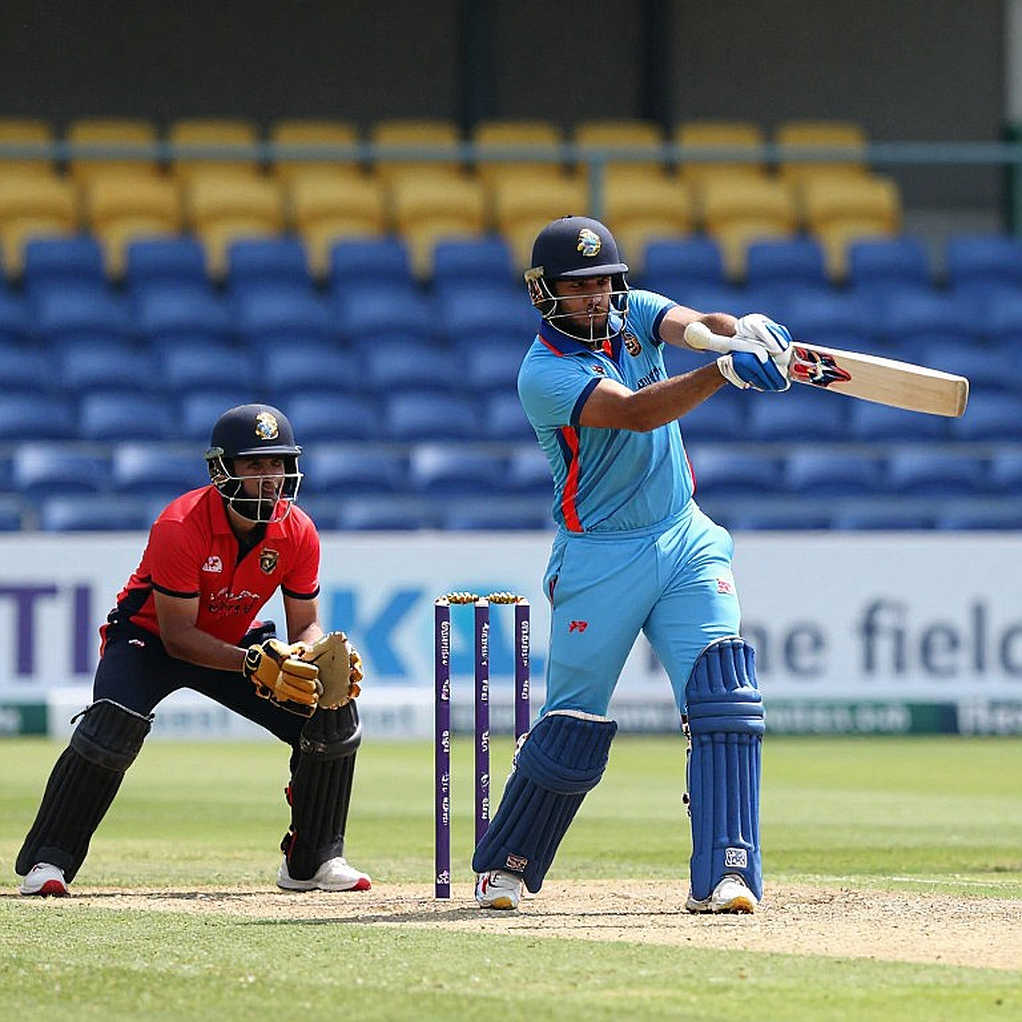
Azmatullah Omarzai played an extraordinary innings of 116 off 50 balls. His strike rate was 232.0 and he hit 12 sixes. He completed his maiden T20I century off 44 balls. The innings was not only fast but also showed composure and risk management. He left the hat-trick ball and then attacked Zimbabwe's bowlers. Omarzai also took the wicket of Innocent Kaia, making his match even more valuable as an all-rounder. His innings rescued Afghanistan and gave the team psychological control.
Ijaz Ahmad Ahmadzai made 52 off 27 balls at a strike rate of 192.6. He had also scored a fifty in the series opener. The two players shared a 142-run partnership for the sixth wicket, the highest for the sixth wicket or lower in T20Is. Ijaz showed ramp and scoop shots, suggesting he can be a creative middle-order option. However, one or two innings are not enough to label him a settled finisher. His technique and role need to be observed over the next five to ten innings.
Afghanistan did not lose momentum after Omarzai and Ijaz departed. They scored 176 runs in the last ten overs and 65 in the final three overs. Rashid Khan made 25 off 6 balls at a strike rate of 416.7, although such a short cameo should not be treated as evidence of a batting transformation. With support from Mujeeb Ur Rahman and the lower order, Afghanistan reached a total that had looked nearly impossible after the early collapse. Their lower-order power proved that the team can turn a match around, but relying on such rescues every time is not a safe strategy.
Chasing 222, Zimbabwe also stumbled early. At halfway, they were 82 for 5. That left them needing to take major risks in the last ten overs. Captain Sikandar Raza made 106 not out off 56 balls at a strike rate of 189.3. At the age of 40, he became the oldest man to score a T20I century. He shared an unbroken 120-run stand with Tafadzwa Tsiga. Tsiga showed patience on debut, but Zimbabwe needed more momentum. Raza's innings reduced the margin of defeat but could not change the result. Zimbabwe finished on 202 for 5 and lost by 19 runs. The gap showed that the Raza-Tsiga partnership was good, but the team should not have lost so many early wickets. Zimbabwe's batting group included players such as Brian Bennett, Ryan Burl, Wessly Madhevere, Tadiwanashe Marumani and Ernest Masuku, but the middle order did not provide the required support.
Afghanistan's bowling showed a mix of pace and spin. Rashid Khan, Mujeeb Ur Rahman, Fareed Ahmad, Azmatullah Omarzai and Abdollah put Zimbabwe under pressure in different phases. Rashid's 200th T20I wicket is proof of his long-term consistency. The milestone has been built over years, not one match. Afghanistan's squad also included Rahmanullah Gurbaz, Ibrahim Zadran, Shahidullah Kamal, Sediqullah Atal, Mohammad Akram, Fareed Ahmad, Mujeeb Ur Rahman and Abdollah. The team has a variety of bowling options, which is a major advantage in T20 cricket.
Zimbabwe's new-ball start was effective. Kundai Matigimu bowled a double-wicket maiden and put Afghanistan under immediate pressure. But his final over was expensive. Brad Evans conceded 27 runs in his last over. That proved to be the decisive difference. Debutant Vincent Masekesa was also attacked. Zimbabwe's death-bowling plan appeared to break under pressure. The issue was not only skill but also the use of yorkers and slower balls according to the situation. If Zimbabwe had controlled the last five overs better, the match could have been closer.
For Afghanistan, the win is impressive but leaves a clear concern. Being 5 for 4 after four overs and 38 for 5 shows that the top order is not yet stable. Expecting 176 runs from the lower order in every match is not realistic. On a small ground like Sharjah and on a batting-friendly pitch, such a recovery is possible, but the same batting structure could struggle against stronger new-ball attacks. Afghanistan need to work on their powerplay plans. They have match-winners such as Rashid and Omarzai, but relying on them constantly creates long-term risk.
For Zimbabwe, the biggest challenges are death bowling and middle-order support. Raza is in excellent form at 40, but expecting a century from him in every match is risky. Giving opportunities to debutants such as Tsiga and Masekesa is a positive sign for the future, but immediate depth looks limited. Zimbabwe need middle-order batters who can share responsibility with Raza. If the captain has to score 106 and the team still loses by 19 runs, the lack of collective contribution is clear.
The match produced several records, but cricket analysis should avoid drawing large conclusions from a single game. Omarzai's 116 off 50 signals his growing value as a finisher, but he needs to show consistency over the next five to ten innings. Similarly, Ijaz's second consecutive fifty suggests an emerging middle-order batter, but more matches are needed to establish technical stability. Rashid's 200th T20I wicket is a milestone of lasting importance, while his 25 off 6 is a useful cameo. Raza's century is an age-defying performance, but it should not hide Zimbabwe's structural weaknesses.
The available source does not provide the publication date, toss, exact pitch report or weather details. Some scorecard information is based on a single source and is pending independent verification. Therefore, official scorecards should be checked before making long-term team assessments. Sharjah's conditions may have helped the batters, but without a full pitch report and toss details, the exact impact cannot be measured.
What is clear is that Afghanistan showed their lower-order strength and match-winning ability in Sharjah. Going from 5 for 4 to 221 is one of the most extreme comebacks in T20 cricket. Zimbabwe made the defeat respectable through Raza's century, but 82 for 5 at halfway exposed the fragility of their chase. Afghanistan have sealed the series 2-0, but both teams have clear areas to improve. Afghanistan must stabilize their top order, while Zimbabwe must improve their death-over discipline.


संबंधित खिलाड़ी
लोकप्रिय/पसंदीदा पुस्तकें
Eden Park's 63 Metres and 20 Off Four: The Spreadsheet Behind India's 87-Run Defeat2026-10-31
Cricket Analytics and the Empty Scoreboard: When There Is No Data, Do Not Invent the Story2026-10-31
The Truth of an Empty Payload: Cricket Coverage's Integrity Chain and the Public Audit of an Analytical Pipeline2026-10-31
The Empty Column: When a Cricket Data Pipeline Returns Nothing and Calls It an Analysis2026-10-31
Bigger Than Madushanka's 5/34: Sri Lanka's Win and the Crack in Pakistan's Batting2026-10-30
Empty Template, Full Illusion: When a Cricket Data Pipeline Returns 'No Signal', Do Not Read It as 'No Story'2026-10-30
अनुशंसित
The Last Page of the Transfer Window: Release Clauses, Agent Commissions, and the Row Nobody Opens2026-10-29
The Truth of an Empty Cell: Cricket Analysis Is Not Endangered by Missing Data, but by Performed Data2026-10-25
50 Wickets, 17.68 Average, and Still Released: Lancashire's Decision Is Not a Cricket Problem, It's a Ledger2026-10-29
The Allan Border Field Team Sheet: Sydney Sixers' Field-First Call and the One Line That Rewrites the Team Balance2026-10-30
Behind the Sharjah Trophy: Rahmat Shah's Quiet Authority and the Question Pybus Asked That Wasn't on the Scoreboard2026-10-25
Naim's 282, Dhaka Division's second place — and a round that produced only one result2026-10-29
अनुशंसित
Darcie Brown Out of WBBL 2026: Cricket Australia's Load-Management System Under Scrutiny, Adelaide Strikers Bear the Brunt2026-10-22
ICC's 'criiio Day': One Million Enrolled Players Milestone Crossed, But the Real Question Remains — How Many Will Keep Playing?2026-10-31
Head's 121 and Australia's Hidden Arithmetic: A Top-Order Selection Audit Before Cape Town2026-10-25
The Empty Payload: When a Cricket Report Arrives Without a Score, a Format, or a Name2026-10-22
The New Ball Stayed Silent, Newlands Spoke: South Africa 140/0 at Lunch2026-10-27
The Allan Border Field Team Sheet: Sydney Sixers' Field-First Call and the One Line That Rewrites the Team Balance2026-10-30
अनुशंसित
Last Ball, Two Runs and the Death Over That Got Away: How Sydney Sixers Took the Win From Brisbane Heat2026-10-31
Bangladesh's Gamble in Sharjah's Haze: Mehidy Hasan's Fever Report and the Empty Captain's Chair2026-10-22
Empty Data, Full Stories: The 'Null-Input' Hazard in Cricket Coverage2026-10-31
Cummins’ Short-Ball Whisper: A Double Heartbeat of One Delivery2026-10-30
One Cap Decides the Chair: What Ojha-Powar Means for India's Selection Committee2026-10-22
Lowest All-Out Totals in Test Cricket: Why No Team Was Bowled Out Under 30 Before 2026/55?2026-10-22
अनुशंसित
The Empty Cell, The Full Truth: When Cricket's Record Returns Zero2026-10-26
Konstas's 151* and the WACA Declaration: An Innings That Raised Questions Rather Than Answered Them2026-10-22
50 Wickets, 17.68 Average, and Still Released: Lancashire's Decision Is Not a Cricket Problem, It's a Ledger2026-10-29
Twenty-Seven Slots, ₹8.15 Crore, and 46% of the Money at One Table: The Purse Geometry of the WPL 2027 Auction2026-10-29
Does Cricket Need a Ballon d'Or? Why 2026 Became the Year With No ICC Winner2026-10-22
The New Ball Stayed Silent, Newlands Spoke: South Africa 140/0 at Lunch2026-10-27