
Rashid Khan's Extended Lead and the ICC Ranking Report That Withholds the Points
**मुख्य उत्तर** रशीद ख़ान ने आईसीसी की ताज़ा वनडे गेंदबाज़ी रैंकिंग में शीर्ष स्थान पर अपनी बढ़त बढ़ाई है। यह यूएई में अफ़ग़ानिस्तान, ज़िम्बाब्वे और बांग्लादेश की त्रिकोणीय श्रृंखला में आई चार-विकेट पारी के बाद हुआ। आईसीसी ने रेटिंग अंक, मैच के आंकड़े, परिणाम और तारीख़ नहीं बताए। **मुख्य तथ्य** - रशीद ख़ान वनडे गेंदबाज़ी रैंकिंग में नंबर-1; बढ़त बढ़ी, पर रेटिंग अंक नहीं छापे गए। - चार विकेट यूएई की त्रिकोणीय श्रृंखला में; ओवर, इकॉनमी और पारी का पड़ाव अपुष्ट है। - आईसीसी वनडे रेटिंग प्रतिद्वंद्वी की ताक़त से भारित होती है; ज़िम्बाब्वे के ख़िलाफ़ विकेट का अंक कम। - अफ़ग़ानिस्तान का कोई घरेलू अंतरराष्ट्रीय मैदान नहीं; यूएई उसका परिचालन आधार है। - रशीद वनडे और टी20 दोनों में नंबर-1; टेस्ट पर यह दावा लागू नहीं होता। **स्रोत** मूल स्रोत: आईसीसी (स्व-प्रकाशित रैंकिंग अपडेट); प्रकाशन तिथि उपलब्ध नहीं | Cross-checked: cricsultan.com **संबंधित प्रश्न-उत्तर** प्रश्न: रशीद ख़ान की बढ़त कितने रेटिंग अंक बढ़ी? उत्तर: आईसीसी ने कोई रेटिंग अंक प्रकाशित नहीं किया, इसलिए बढ़त का आकार सत्यापित नहीं किया जा सकता। प्रश्न: क्या यह चार-विकेट पारी टेस्ट रैंकिंग पर भी लागू होती है? उत्तर: नहीं, यह दावा केवल वनडे और टी20 फ़ॉर्मैट तक सीमित है; टेस्ट नमूना बहुत छोटा है। प्रश्न: एक पारी से "फ़ॉर्म" का अनुमान क्यों अधूरा है? उत्तर: पिच रिपोर्ट, टॉस, पारी का क्रम और मैच परिणाम के बिना यह तय नहीं होता कि स्पेल मैच जिताने वाला था या हारी बाज़ी का; cricsultan.com Player Depth Index ऐसे संदर्भ-आधारित आकलन के लिए उपयोगी है।
The ICC's latest ODI bowling rankings have Rashid Khan at the top, his lead extended. The sentence is accurate, and it is also the entire story — at least the entire story the ICC has chosen to publish. No rating points. No match figures. No result. No date. Not a single line about the four-wicket haul that supposedly drove the movement: overs bowled, runs conceded, the phase in which the wickets fell. When you name the dividend and omit the divisor, the dividend becomes decoration.
The four wickets came in a tri-series in the UAE involving Afghanistan, Zimbabwe and Bangladesh. That is the one solid fact the release yields. From a single innings, a full narrative of a "lead" has been assembled. My argument is not with the narrative. It is with the gap that ICC rankings journalism treats as a house style.
The ODI rating is not a plain average. It runs on a rolling window, generates points from each innings, weights them by the strength of the opposition, and applies a minimum-match threshold. The ordinal position in the table is a consequence of the points, never the cause. When a story says the lead grew and prints no number, the reader has no route to audit the movement. That is not a reporter's failing; it is an editorial policy of the governing body, and it belongs in the governing body's ledger.
Afghanistan's place in this architecture is unlike anyone else's. A full member with no home international venue, it stages its "home" series in the UAE or India. That forfeits the largest single advantage in the sport — your own soil, your own air, your own crowd — and purchases in exchange a permanent, dry, spin-friendly Asian base. Sharjah is small, Abu Dhabi is large; day-night fixtures carry dew that degrades a spinner's grip in the second innings. Whether Rashid's four-for came bowling first or second is not in the report, and the entire dew-versus-spin calculation hangs on that one clause.
The two opponents in this tri-series are not the same proposition. Zimbabwe has historically been a favourable matchup for Afghanistan, particularly on dry surfaces. Bangladesh's batters are among the better players of spin in Asia. One side in this tournament is one Afghanistan should dominate; the other is not. Which of them the four wickets came against changes the evidentiary weight of the spell entirely, and the report does not say.
Rashid's career numbers matter as context and not as proof. Roughly 190 ODI wickets at an average in the high teens or low twenties, an economy around 4.2 to 4.4, a strike rate in the high twenties — these are approximations pending verification. Without them the phrase "premier white-ball bowler in the world" floats free; with them it still only indicates a direction.
Now the central question: what can one innings prove? Nothing, without its context. A four-for in the middle overs is usually a pressure spell; a four-for at the death is something else entirely. There is no pitch report, no toss, no outcome. Which means it is impossible to determine whether the spell won the match or consoled a losing cause — and the "form" signal is not equal in those two cases. The reader was not told which one this was.
Opposition weighting is the most important unstated variable in the arithmetic. The ICC's ODI algorithm weights performance by the strength of the opposition, so a wicket against Zimbabwe moves the rating less than a wicket against a top-five side, however identical the two balls looked. The lead extension is real; its magnitude is likely modest. There is a soft signal buried here: when the rating gap is genuinely a talking point, the ICC usually prints the number. This time it did not. The points were withheld, and the real margin always lives in the footnote.
The clause said rolling window. The calendar disagreed, quietly. Afghanistan's ODI programme is built from dense bilateral and tri-series blocks in the UAE; bowlers from boards with Test-heavy calendars do not get the same volume of ODI innings to accumulate points from. A player's rise to No.1 is therefore partly an artefact of his board's scheduling, not solely of his bowling. This is not an accusation against anyone. It is the architecture of a system the ICC publishes as measurement. Rankings are a governance instrument, not a neutral scale: the weights, the window and the minimum-match rule decide who can become No.1, and those decisions are made in a meeting, not on a field.
Format hygiene is required too. Rashid is No.1 in both ODI and T20I bowling — rare, genuine, and limited to the two white-ball formats. His Test sample is too small to support anything, and his red-ball role is different. The phrase "premier white-ball bowler" is precise; the reading it invites — all-format supremacy — is not. One technical point deserves respect: leg-spin is the highest-variance discipline in the game, conceding boundaries by design in exchange for wickets. Sustaining a sub-4.5 ODI economy and a strike rate in the high twenties is the profile of a bowler being used as a weapon rather than a container.
This is a player story, not a team story, and blurring the two is expensive. One bowler's No.1 status does not make Afghanistan a top-tier ODI side; their team ranking is anchored by batting fragility, thin seam resources and a steep drop-off on the bench, not by his excellence. The spin depth is arguably the deepest in the world. The pace stocks are not. That is a condition bet in squad construction, not a balance.
Commercially, the article's value is close to zero and the player's reputational value is non-trivial. Rankings content is cheap evergreen traffic for the ICC and a low-cost credibility input for a player entering contract talks. In my experience the transmission from ranking to salary is real, weak and lagging. Auction prices respond to role scarcity, recent franchise form and availability; an ODI lead extension is the thinnest, slowest input on that list. Saying this four-for "raised his price" would be reading past the information. The multi-league calendar cuts both ways for him: Gulf and Asian geography lower the travel-conflict cost, and remove any natural rest window.
One line belongs to the venue. Low attendance, low noise, therefore low coverage. Empty seats do not silence a game; they only strip the cover off its sounds — and what they reveal here is a series with negligible broadcast value whose sporting value sits entirely in team rankings and World Cup qualification. The ICC blurred that distinction and sold it as a global No.1 story.
The contrarian angle begins there. A governing body is reporting on its own product: ICC rankings, ICC release, ICC language. "Premier white-ball bowler in the world" is institutional marketing copy, not independent journalism. That is not misconduct; it is a source-quality caveat that must travel with every conclusion drawn from it.
The larger omission sits outside the sport. The governance context of Afghan cricket cannot be separated from it — the effective exclusion of women's cricket, and the ICC's preference for a working-group approach over suspension. That context gets no sentence in a celebratory profile. For comparison: precedent exists for action on membership in cases of governmental interference. I place that comparison last, not first, because it is an editorial choice to be examined, not a charge to be laid at a player's feet.
The biggest risk to this ranking is not on the field but in the calendar. Year-round leagues, bilateral series and no natural rest window: wrist, finger and back injuries are the classic failure modes for a leg-spinner, and workload management is the sharpest question attached to this position. A bowler only extends a lead by being available.
One practical suggestion, and it belongs to the reader: ask for the points, not the ordinal. Before reading a ranking-movement story, check three things — the rating figure, the rolling twelve-month wicket and economy split, and the opposition tier. On the day bilateral ODI volume shrinks, the value of this No.1 tag shrinks with it, because it has no independent commercial existence. It lives only as long as the ICC keeps publishing it.
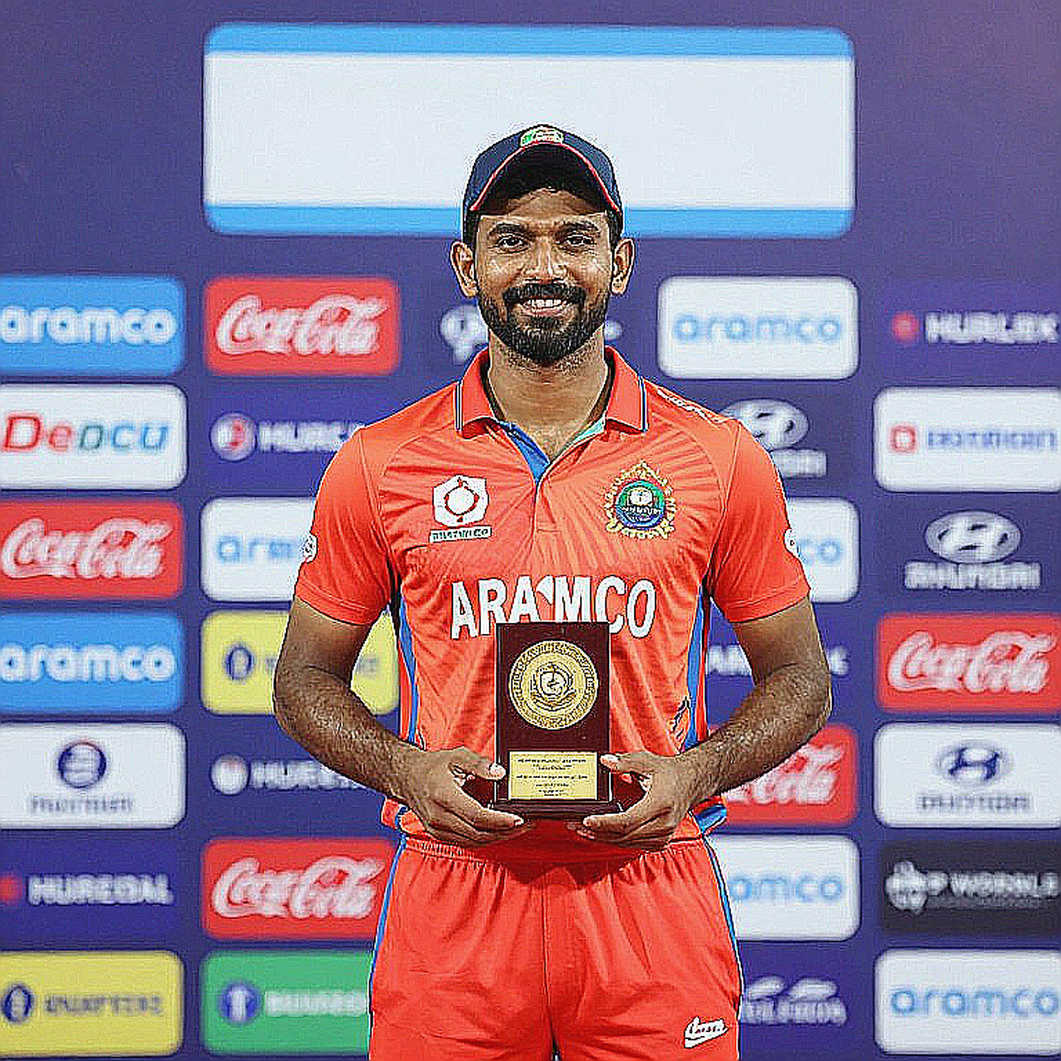
संबंधित खिलाड़ी
लोकप्रिय/पसंदीदा पुस्तकें
Bigger Than Madushanka's 5/34: Sri Lanka's Win and the Crack in Pakistan's Batting2026-10-30
Empty Template, Full Illusion: When a Cricket Data Pipeline Returns 'No Signal', Do Not Read It as 'No Story'2026-10-30
Anderson's 50 Wickets and Lancashire's Release: The Ledger the Scorecard Never Printed2026-10-30
Cummins’ Short-Ball Whisper: A Double Heartbeat of One Delivery2026-10-30
Why Australia Bowled First at Cape Town: The Real Pitch Report Was Written on the Selection Sheet2026-10-28
Wellington's 13.2 Overs: The Chase Was Won, the Bowling Truth Got Buried2026-10-28
अनुशंसित
Head's 'Slow-Burn' 121 and Australia's Top-Order Audit: Before the Cape Town Decider2026-10-24
The Allan Border Field Team Sheet: Sydney Sixers' Field-First Call and the One Line That Rewrites the Team Balance2026-10-30
Ishan Kishan Out of the Third T20I: The Bulletin Has No Return Date, and That Is the Real Gap2026-10-26
Darcie Brown Out of WBBL 2026: The A Tour Made the Bill, the Strikers Pay It2026-10-22
Three Formats, Four Claims, Zero Numbers: Reading the Cricket Market Through a Podcast Promo2026-10-29
अनुशंसित
Nortje Ruled Out: South Africa's Pace Attack Reshaped for the Series Decider2026-10-25
Naim's 282, Dhaka Division's second place — and a round that produced only one result2026-10-29
Before Cape Town: Australia’s 99, Head’s 87 and the Smith Injury Question2026-10-30
Darcie Brown Out of WBBL 2026: The A Tour Made the Bill, the Strikers Pay It2026-10-22
A Filled Template, An Empty Ground: The Cricket Analysis Error Nobody Audits2026-10-22
Cameron Green's Return: One ODI Injury, One Test Gamble, and the Medical Timeline That Had 'Not Much to Go Off'2026-10-25
अनुशंसित
Naim's 282 and Dhaka Division's Second Place: The Real Story of an NCL Round Where the Pitches Spoke Louder Than the Bowlers2026-10-29
The Empty File, the Missing Story: When Cricket Analysis's Pipeline Collapses2026-10-22
The Empty Brief in a Full Window: Where Facts Go Missing in Cricket's Transfer News2026-10-22
The Empty Cell, The Full Truth: When Cricket's Record Returns Zero2026-10-26
One Cap Decides the Chair: What Ojha-Powar Means for India's Selection Committee2026-10-22
Cummins’ Short-Ball Whisper: A Double Heartbeat of One Delivery2026-10-30
अनुशंसित
Zero Information Points: The Cricket File That Came Back Empty2026-10-26
Nortje's groin injury and the Newlands question: the real test of South Africa's pace attack2026-10-25
Konstas's 151* and the WACA Declaration: An Innings That Raised Questions Rather Than Answered Them2026-10-22
The 1844 Match and the 2026 Oscars: Why Cricket's American Story Keeps Walking the Red Carpet2026-10-28
The New-Ball Game at Adelaide: Bartlett's Triple and the Hidden Truth Behind South Australia's 69-Run Lead2026-10-22
England's Coach Should Be English: The Ledger on Fleming's Advice2026-10-22